
Girona's Jewish Quarter (El Call): Self-Guided Walk
Updated
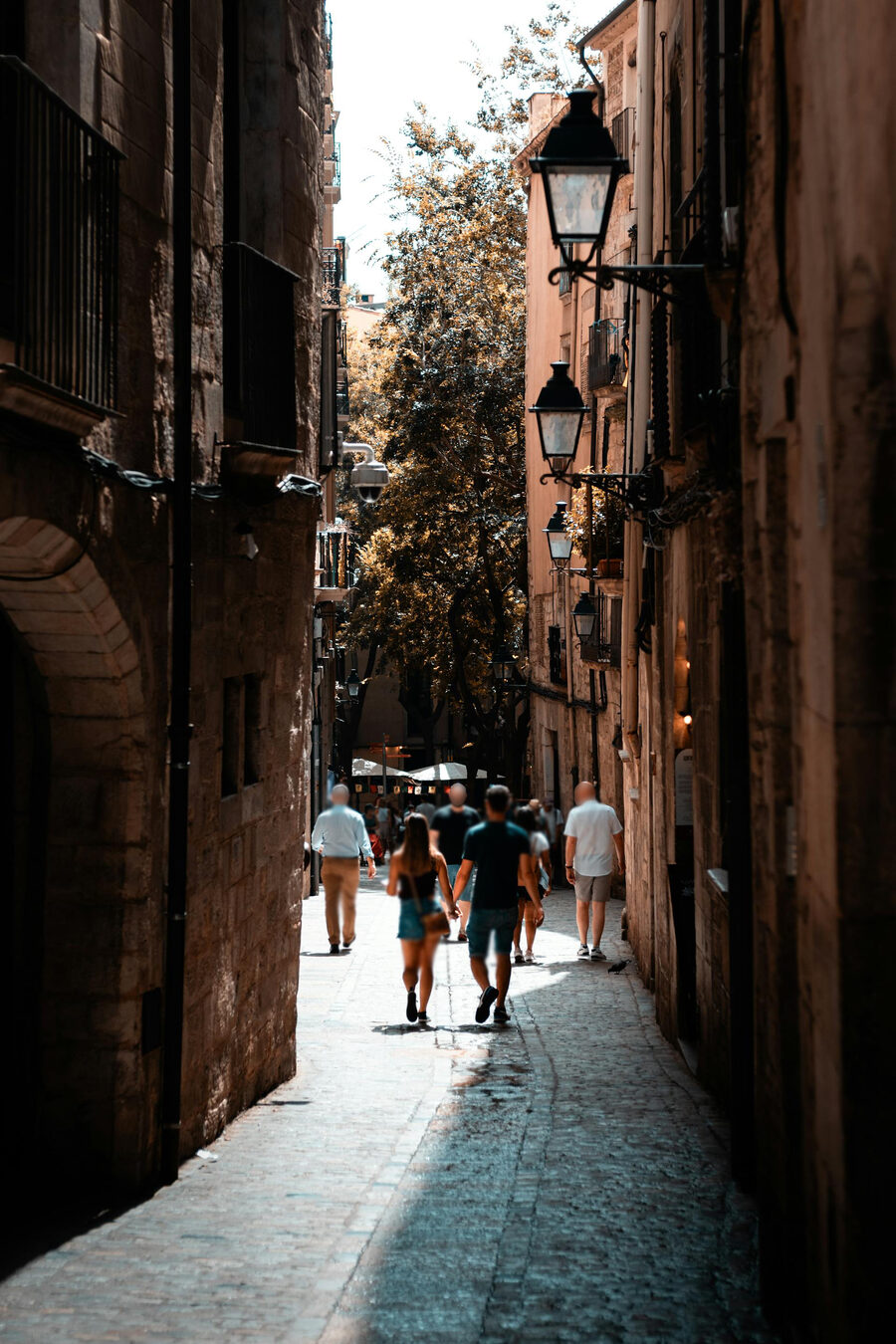
For about six hundred years, the steep lanes below Girona Cathedral were home to one of the most important Jewish communities in Catalonia. Then, in 1492, they emptied. The houses were built over, the passages were closed off, and the quarter was largely forgotten until the 1970s.
Today El Call (the Catalan name for a Jewish quarter) is one of the best preserved in Europe, and the whole of it fits into a walk of under 600 metres. This guide gives you its story, a route through the lanes, and the small details most visitors walk straight past.
The short version:
- Time: about an hour for the walk, two hours with the museum.
- Cost: the streets are free. The Jewish History Museum is around €6, and free on the first Sunday of the month.
- Shoes: the lanes are steep, cobbled and full of steps.
A short history of El Call
The beginning. At the end of the 9th century, about 25 Jewish families settled beside the cathedral, under the protection of the Count. Within a century there was a synagogue, and by the 12th century the quarter had a name: the Call.
The golden age. In the 12th and 13th centuries, Girona’s community was famous far beyond Catalonia. A circle of scholars here, among them Azriel of Girona, became the first kabbalists of the Iberian Peninsula. The most famous son of the Call was Nahmanides (Mossé ben Nahman, known in Catalan as Bonastruc ça Porta), born here in 1194. He was a rabbi, physician and commentator on the Bible. In 1263 he defended Judaism in a public disputation in Barcelona, before King James I. Church pressure afterwards forced him into exile, and he reached the Holy Land in 1267.
The attacks. On 10 August 1391, as violence against Jews spread across the Iberian kingdoms, the Call was attacked. Survivors took refuge for about four months in the Torre Gironella, the tower at the highest point of the city walls. The community never fully recovered. The great synagogue closed in 1415, and in 1448 Jewish families were confined to the Call.
1492. The expulsion order of the Catholic Monarchs ended the story. By then only about two dozen families remained, and they left that summer.
Forgotten and found. The houses passed into private hands, the quarter was built over and its passages were closed. Its rediscovery began in the 1970s with a local enthusiast, Josep Tarrés, who bought houses on Carrer de la Força and ran them as Isaac el Cec, a bar and cultural venue. From 1987 the City Council bought the buildings, and the Jewish History Museum opened its first rooms in 2000. In 2014, excavations in the museum’s courtyard identified the ritual bath, the mikveh.
The walk
1. The foot of Carrer de la Força
From Plaça de l’Oli, walk a short way north to where Carrer de la Força begins, at the Placeta del Correu Vell. This is the spine of El Call. It follows the line of the Via Augusta, the Roman road that ran through Girona, and for a while it was simply called “the street of the Call”. The Jewish houses stood along it and in the lanes that climb off its east side.
2. The Bonastruc ça Porta Centre, Força 8
A short way up is the building that holds the Jewish History Museum and the Nahmanides Institute. It stands on the site of the Call’s last synagogue. Across the street, look at the doorway of number 17: the groove cut into the stone of its jamb once held a mezuzah (more on those below).
3. Carrer de Sant Llorenç
The narrow lane beside the museum is the heart of the Call, and the most atmospheric few metres of it: stone walls, steps and overhead passages. Climb to the top, where it meets Carrer del Doctor Oliva i Prat. The courtyard of the house on the corner, Casa Colls, has eight mezuzah grooves, some cut into its well. It’s a private house and rarely open, but you can glimpse part of the courtyard from the lane.
4. The upper edge and Carrer de Cúndaro
Oliva i Prat and Carrer de la Claveria mark the upper edge of the old Jewish quarter. From here, head back down towards Força through Carrer de Cúndaro, one of the lanes that ran through the Call, with a stone vault over its middle.
5. Placeta de l’Institut Vell
Back on Força, near the top, look for this small square and the doorway of Força 33, one of the most visible mezuzah grooves in the city.
6. Up to the Cathedral
Carry on to the top of Força and into Plaça de la Catedral. This is where the first Jewish families settled, right beside the cathedral, over a thousand years ago. The hill of Montjuïc, just north of the old town, was the site of the community’s cemetery.
How to spot a mezuzah groove
A mezuzah is a small case holding a parchment scroll, fixed to the doorpost of a Jewish home. When it was removed, it often left a narrow vertical groove in the stone. The museum has catalogued 13 of them in Girona.
Two things to know before you start hunting. By tradition the mezuzah goes on the right-hand doorpost as you enter, but most of Girona’s grooves are in stones that were moved or reused when houses were rebuilt, so don’t expect them where the rule says. The one at Força 17, for example, is on the left. And not every dent in a Girona doorframe is a mezuzah groove, so stick to the recognised examples above.
The Jewish History Museum
Small, well laid out, and the best way to understand what you’ve just walked through. Across eleven rooms it covers the community’s origins, family life, the synagogue, work, the Inquisition and the expulsion. The two highlights:
- The gravestones from the Montjuïc cemetery, with their Hebrew inscriptions, found over the centuries, many during railway works in the 19th century. The cemetery itself has nothing left to visit, so this is where to see them.
- The mikveh, the ritual bath identified in the museum’s courtyard in 2014.
Price: around €6, reduced €3, free on the first Sunday of the month and for under-16s. Hours: September to June, Tuesday to Saturday 10:00 to 18:00, and until 19:00 in July and August. On Sundays, Mondays and holidays it closes at 14:00. Last entry is 30 minutes before closing.
Guided or on your own?
The museum occasionally runs guided activities, so check its agenda, and official guides can be booked through the Girona tourist office. Private houses like Casa Colls open only on special occasions. Otherwise, the route above covers the streets on your own time.
The Parlawalk app plays short stories on its own as you walk, and El Call is one of its five free stops. The other four are the Cathedral, Sant Feliu, the Eiffel Bridge and Plaça de la Independència, all a few minutes away.
Quick questions
Is Girona’s Jewish Quarter worth visiting? Yes. It’s small, but it’s one of the best preserved in Europe, and the museum is excellent.
How long do I need? An hour for the streets, about two with the museum.
Is it free? The streets are. The museum costs around €6, and is free on the first Sunday of the month and for under-16s.
Where next? The Cathedral is at the top of the quarter. For a full day plan, see our Girona day trip from Barcelona guide.
Checked in October 2026. Opening hours and prices change, so check the museum’s website before you go.
Hear El Call as you walk it
El Call, the Cathedral and three more stops are free in the Parlawalk app. Unlock all of Girona for €9.99, once. It works offline.